
UAVs to become an integral part of SF Express’ nationwide delivery network by 2022

Drones are finally becoming an accepted part of last-mile deliveries in the U.S., thanks to the Federal Aviation Administration stepping up and establishing guidelines and requirements.
Earlier this year, UPS, in partnership with Matternet and WakeMed with oversight by the FAA and North Carolina Department of Transportation, began utilizing drone transport as an option for on-demand and same-day delivery to deliver medical samples. The benefits as noted by UPS include the ability to avoid roadway delays, increase medical delivery efficiency and lower costs. UPS is using Matternet drones capable of carrying 5-pound loads over 12.5 miles.
Fast forward to this month and UPS’ subsidiary, UPS Flight Forward Inc., announced it received the U.S. government’s first full Part 135 Standard certification to operate a drone airline. The company will initially expand its drone delivery service further to support hospital campuses around the country.
Meanwhile, FedEx Express launched its drone delivery service this past week in cooperation with Wing Aviation and the result was the first scheduled commercial residential delivery as well as the first scheduled e-commerce delivery via drone delivery trial in the U.S.
A round of applause is due to UPS and FedEx for their endeavors, but they pale in comparison with what is occurring in China. Over a year ago, in 2018, SF Express subsidiary Fengyu Shuntu Technology received the first official permit in China to deliver packages via unmanned aerial vehicles in Eastern China.
Today, SF Express is in the midst of a transformation that includes drones and more. George Li, Group Vice President of SF Express, walked us through SF Express’ plans at Cargo Facts Symposium in San Diego last week.
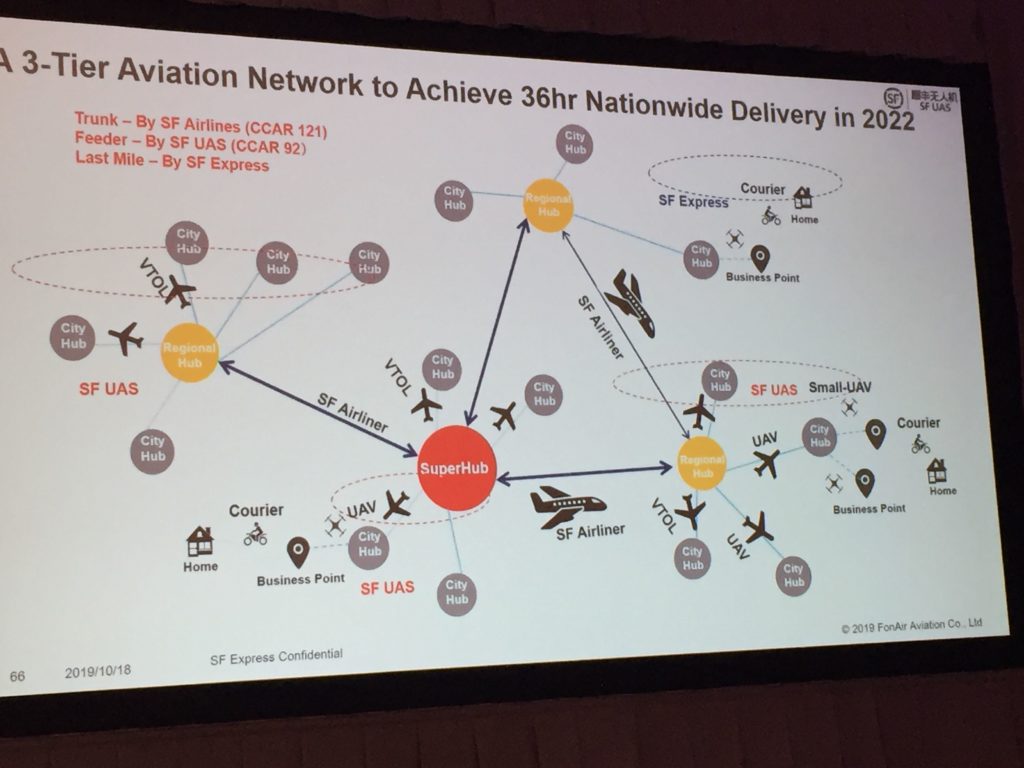
The goal is to achieve a 36-hour nationwide delivery network in China by 2022. Ambitious, true, but Li told the audience that it is doable with the center of this network as SF Express’ Ezhou Superhub, scheduled to open in 2021. It will be Asia’s first and the world’s fourth 4E airfreight hub. Once in operation, it will cover 90% of China’s GDP within a two-hour flight. To support this coverage, SF Express will expand to more than 100 freighters by 2022 to serve the trunk routes and key point to point routes. Beyond these routes, SF Express will use a combination of various types of unmanned aerial vehicles (UAVs) and vertical take-off and landing aircraft (VTOL) to serve city and business hubs. Outside of those hubs, couriers and perhaps some UAVs will serve final mile destinations.
Ahead of the network implementation, SF Express will test three UAVs within its domestic network beginning next year, including two purpose-built freighters and a P750 converted into a UAV. Indeed, testing began in 2017 and by 2018, SF Express was jointly developing such vehicles with companies like China Aerospace Times Electronics. Together, the two firms successfully tested their commercial unmanned aerial vehicle Feihong 98, which has a capacity of 1.5 tonnes and is designed to complete delivery tasks in rural areas, mountainous landscapes, and ocean islands.
Li estimates that UAVs offer a cost savings of 60-70% versus that of traditional airplanes, with much of the savings being no need for pilots. Pilots alone represent about 30% of costs. In addition, there is no need for life support systems such as windows, pressurized cabin, rest facilities, etc., which combined represent an additional 15% of costs. Eventually, when battery technology advances, the use of electric UAVs will reduce carbon emissions and noise pollution as well as enjoy additional benefits such as no fuel.
But are these developments science fiction or the natural evolution of aviation? Morgan Stanley estimates that the global UAV industry will reach $1.5 trillion in 20 years. FedEx, UPS and SF Express are among the many companies including DHL, JD.com, Alibaba and Amazon, that are investing in this technology. How it plays out remains to be seen. There’s still a lot of questions of the viability and practicality of UAVs, but to see them in action is certainly amazing.
Cargo Facts Free Newsletters