
Perishables bear fruit: Why air cargo shouldn’t fear modal shift

 Modal shift by the numbers
Around the world, there are many examples of a rise in perishable commodities being sent by air. Christopher Dehio, head of product and solutions management, temperature-sensitive logistics, for Lufthansa Cargo, said other shifts being reported from sea to air, such as peppers from the Netherlands to the U.S., since the transit time by ocean was too long.
Also, he said, perishable exports from Egypt, Brazil and Chile are still growing, while China is an “increasing import market due to increasing demand for ‘luxury’ perishable goods,” due to growing consumer incomes. “Many customers are looking for freighter service which we can offer from main perishable regions to Europe and further onto other destinations, such as China,” he said.
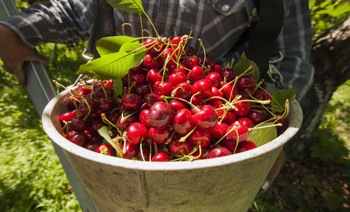
Kerry Galegher, president of AirLogistix USA in Houston, said he is seeing more salmon coming to the U.S. from Norway, as well as higher volumes and more varieties of perishables, such as asparagus, mangoes and cherries, from South America.
During IATA’s World Cargo Symposium, held last March in Berlin, Gerard de Wit, managing director of market analysis firm WorldACD made the case that the airfreight market for perishables has not only gained ground on several trade lanes, in relation to oceanfreight, it will most likely accelerate over the next few decades.
After monitoring millions of air waybills and comparing them to economic predictions over the next 30 years, de Wit said he sees a strong correlation between income growth and consumption of perishables. “Eighty percent of perishable food is imported by developed countries,” he said. “But that is going to change dramatically,” as the world’s middle class population grows larger in places such as China and India.
While the United States and Europe accounted for 60 percent of total perishables consumption in 2000, that amount will dwindle to 15 percent by 2050, de Wit said, quoting from the Organization for Economic Cooperation and Development. India and China,
alone, will represent more than 50 percent of middle-class consumption. Even though perishable food commodities have a much lower yield per kilogram than general cargo, the decrease in U.S.-dollar yields over the last two years has been less significant for perishables than it has been for general cargo, de Wit said.
“You have to analyze the shift per market and per commodity,” he said. The air mode is rising, in relation to ocean, in Hong Kong, Qatar, Singapore, the UAE and Saudi Arabia, according to WorldACD data. Looking at specific lanes, the air transport share of vegetables moving from Europe to Japan rose 4 percent from 2014 to 2015. The same was true for vegetables moving from Peru to Europe (3 percent rise, year-over-year), and India to Europe (2 percent). From Australia to Japan, there was also a huge volume of meat and cheese.
“Perishables is where the growth is,” de Wit predicted. “And most of it will be in developing countries.”


Cargo Facts Free Newsletters