
NTSB hints at ‘pilot error’ as contributor to Atlas 767F crash

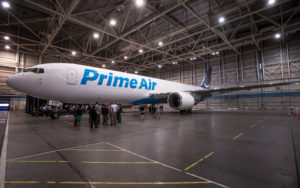 Although the investigation into the fatal crash of Atlas Air Flight 3591 is months away from a conclusion, a story last Friday in the Wall Street Journal said investigators from the National Transportation Safety Board (NTSB) suspect “pilot error,” rather than equipment malfunction, may have “inadvertently” contributed to the accident that occurred outside on Houston.
The 767-300 freighter, operated by Atlas Air on behalf of Amazon, plunged into the shallow waters of Trinity Bay on the outskirts of Houston on Feb. 23, killing the two crew members – Captain Ricky Blakely and First Officer Conrad Jules Aska – as well as a third pilot, Sean Archuleta of Mesa Airlines, who was riding in the jump seat.
According to preliminary reports from the NTSB, the aircraft experienced some turbulence as it was making its final approach to George Bush Intercontinental Airport (HOU) at about 6,200 feet in altitude, prompting air traffic controllers to suggest a descent to about 3,000 feet. At this point, the engines suddenly increased to maximum thrust, which reportedly “startled the cockpit crew,” the WSJ article reported. As the aircraft accelerated, the nose pitched upward, causing the crew to push the nose down to maintain its approach altitude.
However, according to the flight data recovered from the accident, the pitch angle of the aircraft was alarmingly steep, reaching as much as 49 degrees downward – a dive that trained pilots would never attempt in normal circumstances. The freighter’s airspeed also reached 495 miles per hour (mph) – far faster than a normal landing approach speed of about 250 mph.
In the last 18 seconds of flight, NTSB said, the pilots had managed to pull the aircraft’s nose to 20 degrees, but ultimately lost control and ran out of altitude, slamming into the marshland at high speed.
The Airline Professional Association, Teamsters Local 1224, which represents the Atlas crew, emphasized to Business Insider that the true cause of the crash has not yet been determined and that no definitive link has been made between the pilots’ actions and the recorded positions of the aircraft’s flight surfaces.
For those interested in helping to support the families of the three people who perished in the crash, Teamsters Local 1224 said two separate Go Fund Me pages have been established in the names of Atlas’ Blakely and Aska, and also for Archuleta.


Cargo Facts Free Newsletters