
Shifting economic conditions, mixed results in January airport throughput

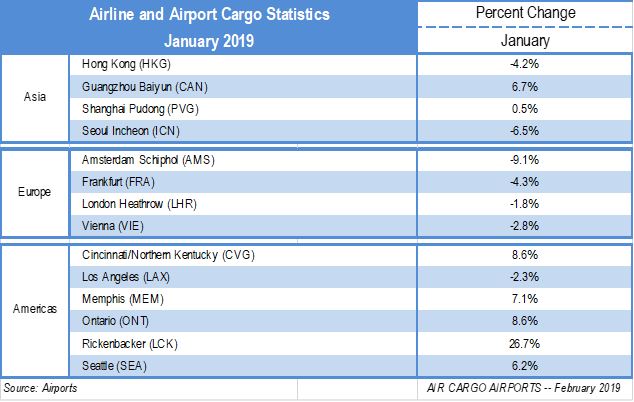 Cargo throughput results for the beginning of 2019 were mixed, with certain regions performing significantly better than others. Airports in North America saw the majority of growth in cargo volumes in January, while airports in Mainland China saw modest rebounds and European airports experienced a continued decline in cargo volumes following an overall diminished 2018 peak season. European airports reported global economic uncertainty as the main cause of weakness in air cargo figures, particularly as the deadline for Brexit is swiftly approaching. Some industry stakeholders have already taken steps to prepare for a potential “hard Brexit.” Carriers’ cargo traffic declined overall in January, particularly in Asia, as reported by our sister site, Cargo Facts. A thaw in tensions between the U.S. and China as talks and delays to tariffs continue could mean good news for the airports going forward this year. Despite volatile economic performance, airports globally, such as San Bernardino (SBD) and Vancouver (YVR), continue to invest in infrastructure and technology for cargo, while others are prepared for the construction of entirely new airports, as in Vietnam and China.
To look more closely at January performance for some of the world’s largest cargo airports:
Asia Pacific
Hong Kong International Airport (HKG) reported its January cargo handle down 4.2 percent y-o-y to 401,000 tonnes. HKG attributed the decline in cargo traffic to continued global economic uncertainty, with imports and transshipments impacted the most – imports declined 8 percent and transshipments declined 6 percent in January.
Guangzhou Baiyun International Airport (CAN) reported its January cargo handle up 6.7 percent y-o-y to 167,249 tonnes – comprised of 156,562 tonnes of freight, and 10,687 tonnes of mail. CAN attributed the year over year increase to growth in both inbound international and outbound cargo volumes at the airport – inbound cargo volumes increased 4.7 percent y-o-y and outbound cargo 4.5 percent y-o-y.
Shanghai Pudong International Airport (PVG) handled 311,000 tonnes of cargo, resulting in a 0.5 percent y-o-y increase in January cargo volumes. Cargo at the airport however, declined 3.7 percent month-over-month from December.
South Korea-based Incheon Airport’s (ICN’s) cargo handle fell 6.5 percent y-o-y in January to 217,473 tonnes. January continues the decline in volumes at the airport beginning in November.
Europe
Amsterdam Schiphol Airport’s (AMS’) cargo handle fell 9.1 percent y-o-y in January, to 122,643 tonnes. AMS attributed the decline to a decrease in both inbound and outbound cargo – inbound cargo fell 9.9 percent y-o-y, while outbound cargo fell 8.3 percent y-o-y in January.
Frankfurt Airport (FRA) reported a 4.3 percent decrease in its y-o-y cargo handle for January, to 163,332 tonnes. FRA said outbound cargo declined 6.3 percent due to export weakness in local markets. Freight carried in the bellies of passenger aircraft was down 2.7 percent and 2.1 percent on freighter aircraft.
London’s Heathrow Airport (LHR) reported a 1.8 percent decrease y-o-y in its January cargo handle, to 132,000 tonnes, marking a rebound in volumes from a disappointing peak season.
Vienna Airport’s (VIE’s) cargo handle, including trucking, fell 2.8 percent y-o-y in January, to 21,226 tonnes. However, overall flight movements at the airport increased 15.3 percent to 18,171 compared to the same period in 2018.
Americas
Cincinnati/Northern Kentucky (CVG) reported that its cargo volumes increased 8.6 percent y-o-y to 104,966 tonnes in January 2019. CVG reported major drivers to overall growth in volumes were express deliveries and freight – air express volumes increased 8.3 percent and freight increased 102.2 percent in January. Growth at the airport can be correlated to Amazon’s announcement of CVG as a hub last year, as well as the addition of several new routes from the airport in 2018.
Los Angeles International Airport’s (LAX’s) cargo handle fell 2.3 percent y-o-y in January to 181,767 tonnes. Freight and mail shipments both contributed to the decline, decreasing 9.7 percent and 1.9 percent, respectively.
Memphis International Airport (MEM) reported a 7.1 percent increase in its January cargo to 25,401 tonnes.
Ontario International Airport (ONT) reported a 5.7 percent increase in its cargo handle y-o-y in January, to 60,532 tonnes. Freight and mail shipments both contributed to the growth, increasing 5.8 percent and 3.1 percent, respectively.
Rickenbacker International Airport (LCK) handled 11,739 tonnes of cargo, resulting in a 26.7 percent y-o-y increase in January cargo volumes. International cargo shipments made up 63 percent of total tonnage, while domestic shipments came in at 37 percent for the month. This growth is likely related to carriers’ – including Alaska Airlines, Delta and United Airlines – addition of domestic and international routes from the airport in 2018, which will continue into 2019.
Seattle International Airport’s (SEA’s) cargo handle increased 6.2 percent y-o-y in January to 34,023 tonnes. The airport attributed the increase to growth in domestic freight, which increased by 11.3 percent.



Cargo Facts Free Newsletters