
Air Canada’s Tim Strauss on the need for a common cargo language


Despite today’s climate of limited government and deregulation, there is at least one industry –airfreight forwarding – that may need regulations and standardization to ensure that it has a future, said Tim Strauss, the new vice president of cargo at Air Canada. While much of the industry is talking about the need for innovation, Strauss said that more ground rules need to be established before the industry can make any progress with new technology.
Just a few months into his tenure, Strauss, former vice president of cargo for Hawaiian Airlines and managing director of global operations for Delta Air Lines Cargo, knows a thing or two about moving forward since he replaced the legendary Lise-Marie Turpin.
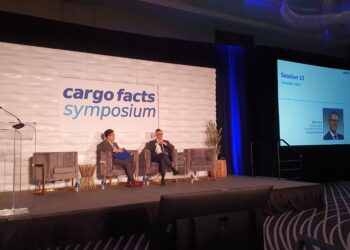
After observing him moderate a panel on Regulatory Compliance, at the May Cargo Networking Services Conference in Orlando, Air Cargo World spoke with Strauss about some of the hurdles that remain for the modernization of the airfreight industry, his thoughts on the second half of 2017 and his account of what it’s like to fill the shoes of a well-respected predecessor.
Q: What do you consider one of the most promising innovations for the industry?
Strauss: The blockchain environment is almost perfectly positioned for the transportation supply chain world. We have all this customs data, but who’s going to collect it, and how is it going to be done? How do we get data in and out of customs quickly in our partly paper/partly paperless environment? In our mind, the blockchain approach would resolve that. IBM has completed a huge project that’s built custom-made for the supply chain business. It’s got the security we need and it’s in a neat bucket, so you’re not crossing over where you don’t need to.
Q: What has been holding the industry back from developing this technology?
Strauss: This is where it gets messy as an industry. We need IATA to lay out a standard, like they did with the Cargo XML language. If we can get the World Customs Organization and others to participate, we can agree on standards for customs data, too. We have to decide what the standards are, so that everybody can build to that. We don’t all have to be on one single platform, but we do need to have a common language, so we can determine what is in place today and what should it look like in seven or eight years – hopefully sooner than that because, truthfully, if we don’t get this straightened out, the forwarding community and almost surely the airlines will not fully participate in the e-commerce world
– it would by default move to the integrator world. At the end of the day, this is about our commercial viability. If there’s no common language, nobody will want to go invest in its potential.
Q: Since you’ve started, are you making any changes in the cargo department?
Strauss: Of course, there’s a lot of status quo, to a degree. But we are adding new routes to Mumbai and increasing our routes throughout Europe this summer. We have a freighter operation in play that’s relatively new and growing in terms of its utilization. Some of those things are in process but need to be taken up a couple of steps. The growth inside the company is probably the single biggest thing we’ll be working on, and it caused us to overwhelm our Toronto hub a bit, so we have to be careful. We’re aiming at a growth pattern through 2030, with a lot of emphasis on cool chain and the perishable world.
Q: What’s it like filling in the shoes of a legend in the business?
Strauss: All the great things they say about [Turpin] are true. She deserves every accolade. She’s leaving at the top of her game and was brilliant at placing people in the right spots – and I’ll have to follow that! But this industry is always in motion, so Lise-Marie, who was always running at full-bore – I think we have a similar attitude. There’s always more to be done and more opportunity – and of course, Air Canada growing internationally, adding close to 40 new widebody aircraft. One of the wonderful things about being here is that there’s a really solid foundation, with very knowledgeable, professional people in every department. I wouldn’t have come here if I didn’t think there was opportunity.
Q: What is your outlook for air cargo for the rest of 2017?
Strauss: I think it’s going to remain strong. The PMI [Purchasing Managers Index] is very strong and has been for most of this year. People are buying up for inventory. If the Trump administration makes any modification in the U.S. tax laws to benefit businesses, that will put accelerant on the growth out of North America, which we share. So that has an interesting halo effect for us here at Air Canada. I think it’s going to be a good year.
Cargo Facts Free Newsletters