Setting the standard: Landing at 100% compliance on electronic air waybills

The carrot didn’t work, so now IAG Cargo is trying the stick.
Thirteen years after the introduction of the electronic air waybill, or eAWB, U.K-based cargo carrier IAG will begin charging customers who are slow to make the transition away from paper, as a way to drive forward the International Air Transport Association’s (IATA) goal of reaching 100% eAWB usage by yearend — a goal the organization failed to reach in 2022.
IAG Cargo, which handles 800,000 tonnes of cargo per year, announced in a press release at the end of February it would begin charging customers 10 euros ($10.72) per shipment for paper air waybills beginning April 3.
With so much emerging technology in the industry, it would seem that the eAWB should have been part of mainstream operations long before now.
While some carriers have already implemented them, a sizable percentage of air cargo carriers and forwarders continue to rely on their legacy paper systems.
A September 2020 report by IATA showed that eAWBs comprised 71.3% of the 836,925 air waybills processed that month, 242,709 shipments being rendered with paper. This is the most recent monthly data IATA has reported.
Developed in 2010, eAWB benefits include sustainability, efficiency, safety and smoother overall operation, per TIACA.

“IAG Cargo adopted eAWB shortly after it was introduced in 2010 to optimize the efficiency of our operations and deliver the levels of performance that our customers expect whilst reducing air cargo’s unsustainable reliance on paper airway bills,” David Rose, chief transformation officer at IAG Cargo, told Air Cargo Next.
Switching to this digital tracking system is crucial to the air cargo industry, he said.
“We recognize that, as an industry, cargo has moved at a slower pace in terms of its digital offering,” Rose said. “We want to change that. Over the last year, we’ve been focused on digital development to streamline the way customers do business with us and offer a more reliable product.”
The paper trail
Paper air waybills long have been the documentation method for cargo shipments between freight forwarders and carriers. They track everything from customs papers to transportation documents to commercial documents, according to Conqueror Freight Network.
The elimination of paper aligns with aviation industry goals to reach net zero by 2050. Like any sector of sustainability, it takes time, and questions loom about its success.
IAG Cargo set a goal of 100% eAWB usage by the end of 2023. While the company said 50% of the air waybills it processes are electronic, it declined to provide Air Cargo Next with exact numbers. In 2021, however, IAG reported it was operating nearly 1 million flights per year, about 20,000 flights per week, which equates to millions of tonnes of cargo, the airline said in a release at the time.
“Our Destination Digital journey at IAG Cargo is a priority for us to help improve the quality of our operation and communication for our customers to drive a sustainable and reliable experience,” IAG’s Rose said.
The paper AWBs processed each year by IAG Cargo weigh about 7,800 tonnes — enough to fill 80 Boeing 747s, the company said. Eliminating the paper is not only a sustainable move, but it helps provide “seamless end-to-end service for its customers and eliminates the risk of human error,” the company said in a release.
“Fewer paper AWBs equals less paper, and particularly if that can be translated into supporting documents as well,” TIACA’s Hughes said. “This combined reduces the environmental impact and saves some trees. Information storage is also a challenge.
“The AWB acts as an invoice and is a contract for transport, which falls under data storage requirement in each country, which can vary but may be up to 10 years. Digital storage is easier, cheaper, and doesn’t require physical space.”
Digitalization increases efficiency
Paper AWBs, on the other hand, can be inaccurate and slow, causing delays and mistakes.
“As digital information moves faster than physical paper, the complexities of the supply chain are more easily addressed if each partner can share and receive shipment information in advance of the actual consignment,” Hughes said. “Customer communication is also more easily managed if the information is digitalized from the outset. Optimized use of facilities and network planning is enhanced if the AWB information is provided electronically. Digitalized AWB information can also support preclearance of consignments, which is just not possible if the paper AWB arrives with the cargo.”

Digitalization and eAWBs take multiple steps out of the process. Paper air waybills must be processed and entered into multiple systems by supply chain partners.
The eAWBs also aid in shipment and processing of specialty goods, including temperature-controlled and other cool chain cargo. An eAWB facilitates awareness in the supply chain of special needs, enabling better quality movement, Hughes said.
Incompatibilities led to slow start
So, with so many digital tools available, why are carriers and forwarders lagging behind the times?
The answer is complex, Glyn Hughes, director general of The International Air Cargo Association (TIACA), told Air Cargo Next.
“The legal framework wasn’t in place,” he said. “The e-ticket can be used in any country which has signed the Chicago Convention, which governs aviation from an international regulatory perspective.”
The Chicago Convention was drafted in 1944 by 54 countries to establish “core principles permitting international transport by air,” according to the International Civil Aviation Organization. Its mission was to simplify air cargo travel.
The process has been anything but simple, however.
There were “incompatible systems,” Hughes said. “More specifically, message formats. … [If the systems are] not the same language, the data isn’t compatible.”
Other issues included agreements between carriers and freight forwarders, which must receive IATA approval, he said. “These collectively were the enablers or blockers. Once the conditions were in place, carriers could move forward … some faster than others as their customers were also running at different speeds,” Hughes added.
Barriers aside, eAWB adoption nearly there
The transition to eAWBs has been slower than IATA would like, and barriers remain. However, several major carriers have targets of reaching 100% eAWBs by the end of 2023.
Delta Cargo said it is nearly there.
“We are over 95% eAWB globally. The long-term goal focus for Delta Cargo is on the quality and timeliness of electronic data,” Drake Castaneda, corporate communications for Delta Cargo, told Air Cargo Next. Delta hopes to hit 100% this year, he added.
The carrier began using eAWBs in 2014 after setting new sustainability standards. By 2015, Delta usage was up to 77% eAWBs.
In 2015, Delta announced in a press release that it processed 37,000 paper AWBs per month. In its first year using the eAWB, the airline said it reduced paper waste by half, processing 14,700 paper AWBs. It estimates that, by making the switch to eAWBs, more than 1,500 trees per year are spared along with 1.5 million gallons of water used in the paper-making process.
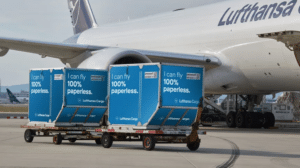
Meanwhile, Lufthansa Cargo said 100% of its shipments were transported utilizing eAWBs in 2022, after the carrier started using them in 2014.
IAG Cargo is looking to close out this year as fully electronic and is willing to penalize customers opting not transition away from paper with its 10-euro charge for paper AWBs.
“With nearly half of IAG Cargo’s customers already using eAWB, we are working with our remaining customers to achieve 100% eAWB by the end of 2023,” Rose said.
“With nearly half of IAG Cargo’s customers already using eAWB, we are working with our remaining customers to achieve 100% eAWB by the end of 2023.”


Cargo Facts Free Newsletters