
The Plum Blossom Soars: How Taiwan’s largest cargo carrier makes freighters work

Blossoming every day
In 2010, after the global recession that affected most markets – except China, the one economic powerhouse with which Taiwan was restricted from doing business – Liu handed off the role of general manager, cargo Americas, and assumed the role of vice president of cargo.
For much of CI’s recent history, its slogan, a reflection on the carrier’s flowery livery, was: “We blossom every day.” Steering one of the world’s largest freighter operators during turbulent times, Liu would face no shortage of difficult situations. But, in spite of adverse market conditions, CI cargo has sought growth and refinement. Since the boom times of the mid-2000s, EVA has winnowed its freighter fleet down to just five aircraft. Liu’s team, meanwhile, parked three of CI’s freighters in 2012, and has for the past five-years, maintained a relatively stable freighter fleet of 18 widebody freighters. “The 747-400F, therefore, remains the backbone of our freighter fleet, though we are continuing to study and assess new types of freighter aircraft.”
In contrast to other airlines, China Airlines has often been eager to work with its forwarder partners, which, in turn, have kept its freighters flying, said Kelvin Lin, regional general manager of northeast Asia air for freight forwarder Dimerco Express Group. “Quality service and space availability are two of the most critical factors for customer satisfaction,” and CI, Lin added, has been able to consistently deliver both.
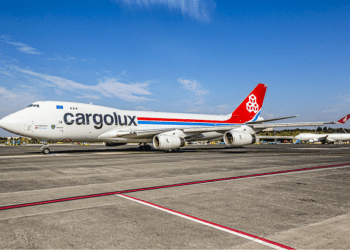
When a sluggish market forced many carriers to reduce freighter capacity between Asia and Europe, CI stubbornly resisted. “Compared with other carriers, China Airlines continues to operate freighters from overseas to TPE from LUX, FRA and AMS,” said Lin. These freighters help Dimerco “provide specific transit times, direct flight services and more stable rates.”
As for the constant migration of manufacturing, even at times when Taiwan’s manufacturing sector took a hit from the loss of a factory, China Airlines’ freighters were not necessarily out of work. Liu recalled how his airline actually “helped many tech companies from Europe, the U.S., and Japan relocate entire plants by air.”
“We believe China Airlines is doing the right thing, balancing belly and freighter capacity growth,” said Kenny Mok, managing director, DHL Global Forwarding Taiwan. “There is plenty of freight which, due to its size and packing condition, still needs to be moved by maindeck freighters.”
But, as CI’s competitors have proved, freighters “can sometimes be challenging for the airline industry,” said Lin. Nonetheless, Mok believes “there is definitely a market for freighter operation in Taiwan.”
Despite signs of recovery in the U.S., the European market was sluggish in 2015, and global air cargo demand stayed flat for most of the year. China Airlines’ cargo traffic rose only 1.4 percent, year-over-year, in 2015. With the expansion of airfreight capacity outpacing the growth in demand, “air cargo yields declined slowly, consistent with persistent weakness in load factors, keeping downward pressure on cargo financial performance,” Liu said.
In such situations, it is common practice to cut capacity and park freighters. But just as the plum blossom refuses to wilt in the winter, CI adopted an unusual strategy that, according to Liu, included:
- maintaining a flexible network to optimize yields;
- expanding the proportion of high-yield freight;
- developing closer relationships with forwarders; and
- using revenue management tools to enhance sales.
By adhering to this strategy, China Airlines has often been at the forefront of emerging opportunities. Take the year 2015, for example: Demand was weak on many routes, but CI boosted freighter frequencies to Hanoi and Ho Chi Minh City, where Vietnam’s nascent air cargo market was starting to take off. It also made Al Maktoum International at Dubai World Central (DWC) its transit point for flights between Europe, Africa and Asia. “Rather than chasing kilos, China Airlines makes efforts to exploit niche market opportunities and strengthen service quality,” said Liu.
Leveraging emerging opportunities requires both freight and the capacity to move it, meaning that any given freighter operation can only be successful if forwarders book cargo. Dimerco’s relationship with China Airlines is “based on the concept of mutual growth and cost/risk sharing,” said Lin.
Having a large freighter fleet certainly helps. Recalling a recent project that required Dimerco to move 10 crates of oversized cargo for a leading semiconductor manufacturer, Lin said China Airlines was able to work closely with the forwarder, to “efficiently solve the space allotment issue, and to move the cargo according to schedule.”

Cargo Facts Free Newsletters