
A Nose for Cargo: Canine screening may become cargo security’s best friend

Olfactory workers
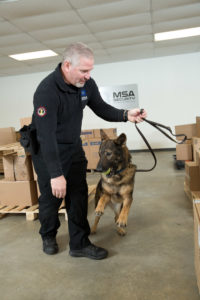
To understand the excitement over the use of canines in air cargo security, one must acknowledge that dogs are truly amazing creatures. Beyond the fact that they are fiercely loyal, hard-working – and, let’s not forget, adorable – companions of humankind, they have noses that beggar the imagination of scientists worldwide.
With up to 300 million olfactory receptors (compared to just 6 million in a human schnozz), a typical dog’s nose is between 10,000 and 100,000 times more sensitive than ours, depending on the breed, and is capable of picking up scents measured in parts per trillion – the equivalent of detecting a teaspoon of sugar dissolved into 1 million gallons of water, or two Olympic-size swimming pools.
Since the Middle Ages, canines have been trained by humans to use their phenomenal nasal abilities to track down criminals, assist in hunting game or find bodies. In the last century, dogs’ nasal repertoire was expanded to police work, sussing out illegal narcotics, stolen money, accelerants at fire scenes and many other hard-to-detect scents. During World War II, the U.S. Army first began “K9 units” to recognize the faint residues of explosives to help detect mines – a job that they have done in war zones ever since.
After the 9/11 terrorist attacks in 2001, however, bomb-sniffing dogs entered a new era of prominence. The 9/11 Commission recommended that 100 percent of everything that travels on a passenger aircraft within the United States must be screened, and those rules have been in effect since 2010. However, the International Civil Aviation Organization (ICAO) has recently removed the distinction between passenger and cargo operations, meaning that, by 2021, all cargo – transported via passenger aircraft or freighters – needs to be screened for explosives. That’s still two years away, but the clock is ticking.
Marc Murphy, director of air cargo and aviation for canine vendor MSA Security, said he has certified “north of 30 teams” under the young program. “We had projected more by this point, but the government shutdown has slowed things a bit,” he said, referring to the impasse between President Trump and Congress over the federal budget, including the funding for a security wall along the U.S./ Mexico border. “For 2019, I think it’s safe to say a goal would be about 200-plus teams.”
Another group of canine-detection companies, known as the Cargo Screening K9 (CSK9) Alliance, has deployed 12 full-time certified thirdparty canine teams to three Able Freight screening facilities in Los Angeles and San Francisco. “Our management team has been working diligently with the TSA for months to become a Certified CCSF-K9,” said Paul Hammond, president of CSK9. “TSA was very responsive in the application approval process in spite of the challenges associated with our large national footprint and geographically separated operations, support offices and training facilities.”



Cargo Facts Free Newsletters