
Atlas Air’s Drew embraces AI boom for internal efficiencies, its cargo business
Cargo Facts Symposium

NASHVILLE, Tenn. — Atlas Air Worldwide is embracing AI as part of its corporate modernization after the company went private in March 2023.
“Rather than actually focusing on individual tasks, it’s about how do we get better at making faster cross-enterprise decisions,” Chief Strategy and Transformation Officer Martin Drew said during a fireside chat today at Cargo Facts Symposium.
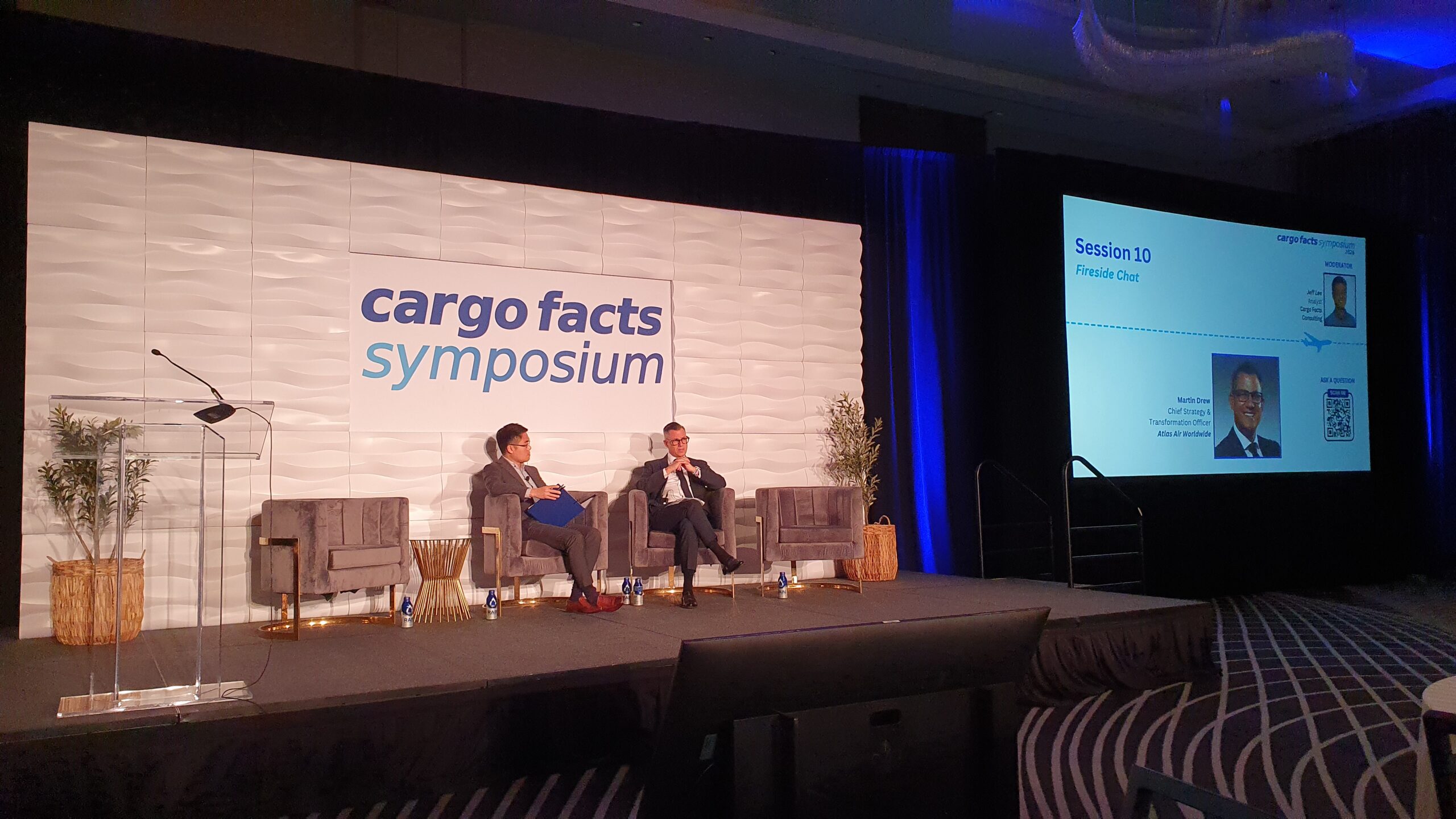
The company, which is the world’s largest provider of outsourced aviation logistics and cargo airfreight, is using AI to optimize fleet planning and crew resources.
For example, Drew said, Atlas Air developed an AI tool specifically for crew planning in case of disruption and recovery.
“We are operating these complex flight patterns all over the world with 3,000 pilots and when we get a disruption, crew pairing breaks,” he said.
“The tool serves up optimized solutions in milliseconds, taking into account the cost, minimizing crew overtime costs and making the optimal decisions. Before, it was very much a manual exercise.”
Atlas has begun developing similar tools for routes and maintenance planning, Drew said.
“These look upstream to assess what the impact will be, ensuring that maintenance still gets efficient time on the aircraft, in the right place, with the right parts, as well as actually looking at the best routing,” he said.
The AI boom and data center construction has proven a windfall to the airfreight industry, including Atlas.
“The data center business seems to be the gift that’s going to keep on giving — it’s growing at an incredible rate,” Drew said.
Data-center-related freight volume in 2025 was about 1.2 million tonnes and is expected to double in 2027, Drew said.
“It’s a two-phase supply chain: Components such as semiconductors, chips, motherboards and GPUs come from Asia to places like Guadalajara, where there are a lot of factories that then assemble the server racks,” he added.
“Then you’ve got the server racks that are then exported all over the world.”
With technology developing at such a rapid rate, obsolescence comes quickly, too, he said.
“Within 18 months to three years, these servers become obsolete and need to be replaced,” he said. “It’s a fascinating business, one that we’ve really capitalized on and we hope that’s going to continue for years to come.”
Stay up to date with the latest news coming from Cargo Facts Symposium here.

Cargo Facts Free Newsletters